

One of the year’s most heartfelt movies features a man made out of wicker. It’s a bold claim, and perhaps an unexpected one after watching the trailer for Wicker. What’s presented as a raunchy, sex-gag-filled fantasy about a woman who has a made-to-order husband fashioned out of wood is a surprisingly tender feminist romance that has more to say about gender politics, love, and relationship dynamics than any other film this year.
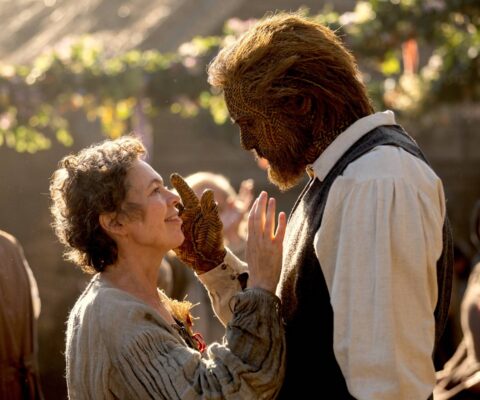
In a medieval village where everyone is known not by their first names but by their occupations, Oscar winner Olivia Colman (The Favourite) is the lonely Fisherwoman. She’s ostracized by the villagers for smelling like the fish she catches, while the women turn their noses up at her for not conforming to their beauty standards and wifely expectations. Grown weary of the town’s scorn, the Fisherwoman asks the local Basketweaver (Peter Dinklage) to make her a husband. He does so with great flourish, fashioning her a devoted and caring man made out of willow (Alexander Skarsgård).
As the Fisherwoman and her Wicker Man become the talk of the town, their happiness threatens the status quo. The village women, led by the Tailor’s Wife (Elizabeth Debicki), grow jealous, while the men become insecure, putting the couple’s fabled wedded bliss in jeopardy.
Adapted from Ursula Wills’s short story The Wicker Husband, co-writers and directors Alex Huston Fischer and Eleanor Wilson position Wicker as part folk tale, part fairy tale, both timeless and timely. The characters are named exclusively after their professions and, in the case of women, their proximity to their husbands’ or fathers’ professions. It’s a choice that allows the social and gender commentary to stand out amid the folktale trappings and distinguishes the Fisherwoman as an outsider from the start. She is the only woman recognized for herself rather than in relation to a man.
Women here are treated as second-class citizens here even though they are the ones really pulling the strings and keeping the town in working order. Weddings involve not the exchange of rings but a ceremonial metal collar clamped around the neck. The Fisherwoman enjoys a sense of freedom compared to her peers, which only further irks the village’s mean girls.
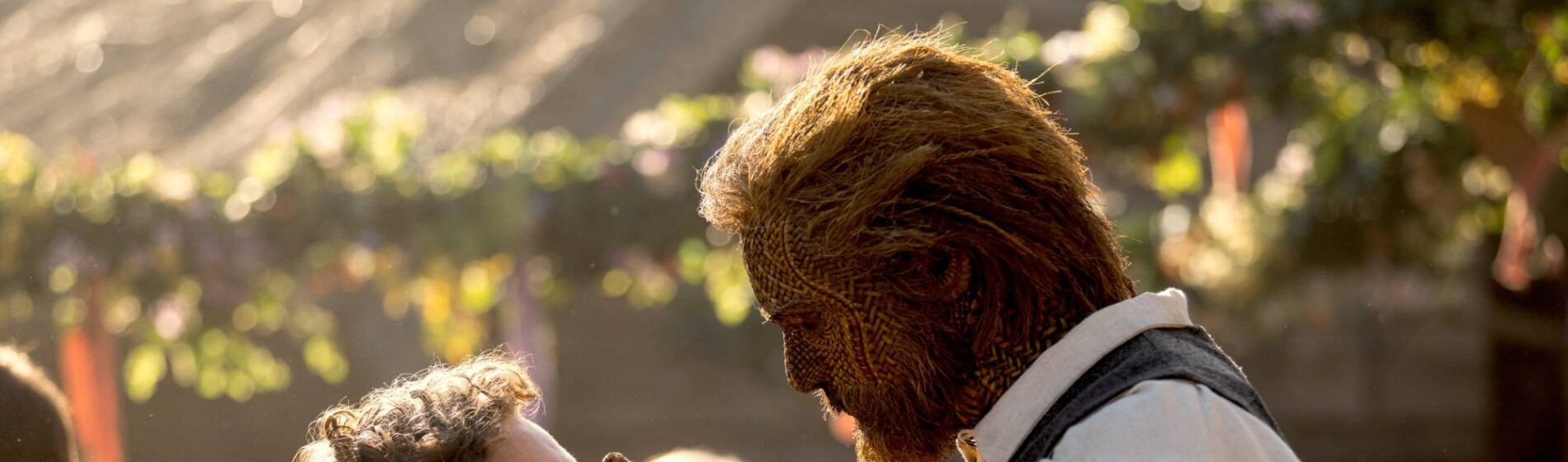
Wicker exists in that romantasy world where things like a Basketweaver making a talking man out of wood don’t need an explanation for how this is possible (none is given, anyways). Not only is the Wicker Husband’s arrival magical, but so is the technical creation of Skarsgård’s character. Built in collaboration with Weta Workshop, the Wicker Husband is undeniably Skarsgård, but also believably wicker. The attention to detail in his design, from his woven muscles to the slightly creaky sound of his movements, is phenomenal. Even during the sex scenes (and yes, there are a few), the craftsmanship remains impressive. He is a wicker man, but soon, it doesn’t really matter what he’s made of, because it’s what’s inside that counts.
The film is firmly rooted in the fairy-tale realm, too. Presented in storybook chapters, Wicker is lensed by The Brutalist’s Oscar-winning cinematographer Lol Crawley with the glow of a magical romantic fantasy. Both rustic and pastoral, Wicker is effectively beautiful. The way light streams through the Wicker Husband’s hands as he reaches for the Fisherwoman is a particularly evocative visual, underscoring the delicate balance between his physical construction and the emotional connection they share.
Stars Colman and Skarsgård have a fun, flirty chemistry rooted in an emotional reality that carries the story forward, even when the circumstances initially seem absurd. Soon enough, the weird and whimsical tone becomes de rigueur and ceases to be a distraction. The dialogue is blunt and raunchy at times, but that’s hardly the film’s defining quality.
The supporting cast is equally superb. As the Dr. Frankenstein-like Basketweaver, Dinklage speaks mostly in poetic monologues. Like the Fisherwoman, he, too, is an outsider who ponders his place in the village and the consequences of his wicker creations. As the Tailor’s Wife and queen bee of the village’s mean girls, Debicki imbues her character with immense sadness and pity. She knows how cruel a wicked word or passive-aggressive remark can be, but she, too, is trapped in a misogynistic society, the effects of which reveal themselves over the course of the film.
Even with all its weirdness and endless memes, Wicker is a surprisingly tender romance that uses its strange premise to explore the expectations placed on women and the ways those expectations shape relationships. Beneath the raunchy humour and the fairy-tale setting is a story about finding love and happiness outside the roles society assigns us. What begins as an absurd fantasy about a woman ordering a husband made of wood becomes something far more heartfelt, proving that the most meaningful connections are not necessarily the ones that conform to convention.